Showing posts with label Google. Show all posts

Sunday, November 28, 2021

Can we take welcome at face value?

Matt Brittin, the President of Google EMEA, has some warm words for the EU Commission's efforts to regulate political advertising.

We share the Commission's goal of increasing the harmonization of Europe’s transparency rules for political advertising and we support today’s introduction of legislation. ... The Commission’s proposal is an important and welcome step.

Karolina Iwańska of the Panoptykon Foundation interprets this as a bad sign for the proposal.

However there are other possible interpretations of Google's position.

The first is a cynical one. It is not uncommon for organizations lobbying against regulation to loudly affirm their support for the general principle, while working behind the scenes to water down any concrete measures. Mr Brittin notes that this is a complex field, requiring a balance ..., and although such words could be based on a sincere desire to improve the proposals, they are also consistent with the cynical interpretation.

But there is another interpretation. However much large companies complain about regulation, they are also aware that regulation serves as a source of competitive advantage for them, since large established companies can absorb the costs of compliance more easily than small players. (In the banking sector for example, this effect was expected to increase polarization between larger and smaller players. And in October 2012 I noted the irony that legislation prompted by bad behaviour by large companies can be more burdensome for small companies than for larger companies.) It also establishes barriers to entry, giving them another layer of protection against anything that might fundamentally disrupt their business model.

Large companies often work behind the scenes to influence the shape of emerging regulation in their favour, and Google is clearly signalling its willingness to appear helpful.

Chapter Four of Shoshana Zuboff's book, which is entitled The Moat Around the Castle, details a broad combination of rhetoric and lobbying carried out by Google and its executives to establish Google's freedom from government regulation. However, this doesn't rule out the possibility that Google now takes a more nuanced position, particularly as much of the public and political attention is currently directed at Facebook rather than themselves.

Welcome back my friends, to the show that never ends ...


Matt Brittin, New EU political ads law is a step in the right direction (Google, 25 November 2021)

Update: See also Interview with Matt Brittin on Channel Four News (2 December 2022)

Natasha Lomas, Report reveals Big Tech’s last minute lobbying to weaken EU rules (TechCrunch, 22 April 2022)

Jane Merriman, Big banks winners from new contingent capital move (Reuters, 27 August 2010)

Shoshana Zuboff, The Age of Surveillance Capitalism (2019)

Related posts: Regulation and Complexity (October 2012), Decentred Regulation and Responsible Technology (April 2019), Amplification and Attenuation (October 2021)

Wednesday, July 26, 2017

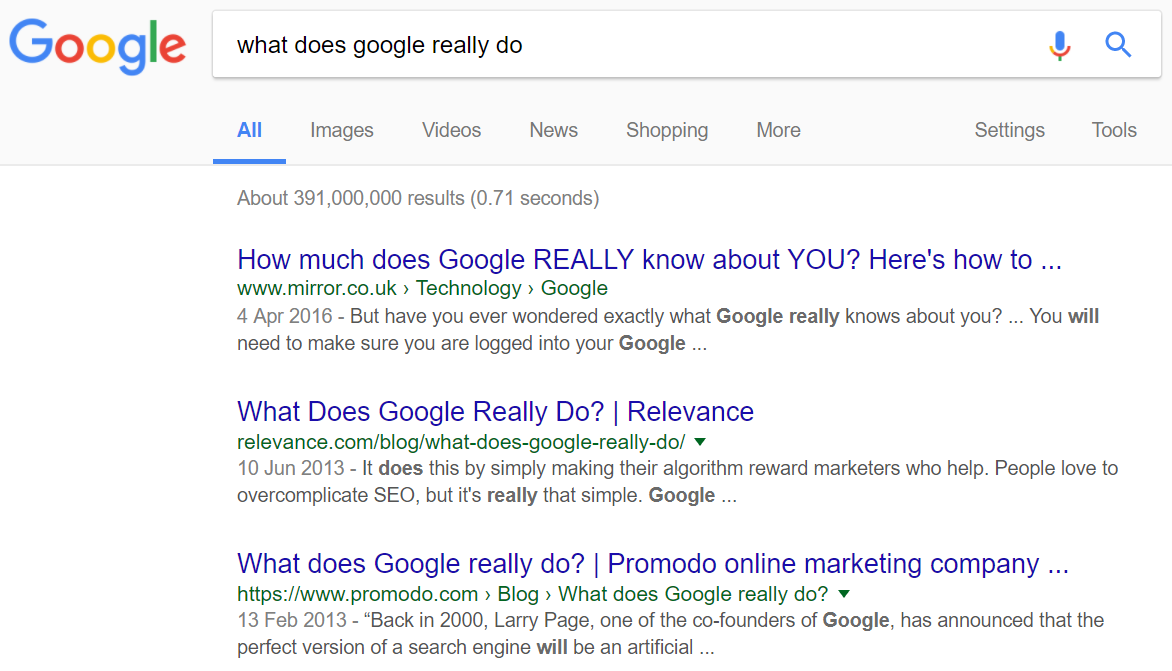
What Does Google Do?

@ManuKumar complains about the obscurity of certain websites.
So how do you figure out what Google does? Google itself suggests I look at an article by @JoannaG in the @Guardian.


But the article is over five years old. It's what Google once did.


So let's have another go. What does Google actually do?


It's the world's largest bus shelter? No seriously, what does Google really do?


So it makes their algorithm reward marketers? It's really that simple?


Joanna Geary, Google: What is it and what does it do? (Guardian, 23 April 2012)

Greg McFarlane, How Does Google Make Its Money? (Investopedia, 22 November 2012)

Relevance Blog, What Does Google Really Do? (10 June 2013)

https://www.google.com/about/

Saturday, April 16, 2011

Is Google rigged?

It seems Google can't do anything these days without courting controversy.

Google has defended recent changes to its search system that reduced the prominence of some popular websites. ... Google's head of search evaluation, Scott Huffman, said it was "almost absurd" to suggest that the results were rigged. [BBC News, 15 April 2011 via Lord of the Universe]

The phrase "almost absurd" falls some way short of a full-bloodied denial: Mr Huffman seems to be conceding that the suggestion is not totally absurd.

Meanwhile the word "rigged" seems ethically loaded. According to Merriam-Webster, the word "rigging" means

1. Making (a sailing ship or boat) ready for sailing by providing it with sails and rigging.

2. Assembling and adjusting (the equipment of a sailboat, aircraft, etc.) to make it ready for operation.

Obviously, Google's page ranking algorithms are designed to achieve certain outcomes. Google is a commercial company, not a supremely neutral enterprise (although some people seem to forget this too easily).

Is there a clear dividing line between designing something and rigging something? Perhaps the word "rigging" implies that there is something unfair, impure or ethically problematic about certain kinds of design thinking?

Monday, December 10, 2007

In the Courts

Christmas approaches, and the courts are getting busy.
  • In the western Greek city of Patras, a parrot is facing a $650 (£320; 444 euros) parking ticket. [BBC News]
  • A judge in India has summoned two Hindu gods, Ram and Hanuman, to help resolve a property dispute. [BBC News]
  • And a 57-year-old man who turned up alive five years after being presumed dead in a canoeing accident is due in court in the UK. [BBC News]

By an interesting twist of fate, the 57-year-old man is called John Darwin. He was caught by a woman who typed his name into Google, and found a photo on a "Move to Panama" website [Daily Mirror, December 6th 2007]. This "long-tail" detective (who doesn't wish to be named) has nominated Darwin and his wife for a "World's Dumbest" award.

But he doesn't qualify for a Darwin Award, contenders for which are required to kill or dismember themselves in some spectacularly stupid accident, preferably before passing on their genes, thus helping to remove their stupidity from the gene pool. John Darwin survived the canoeing accident (although some doubt there ever was a canoe), and his relatives (including his sons) are apparently trying to make things worse for him. So the stupidity lives on.

Update

Wednesday, May 09, 2007

Reinforcing Stereotypes

Google reflects the cumulative errors and distortions of the Internet. Several people (I got it from Radovan - see also Blogoscoped) have recently noticed that if you type "she invented" into Google, you are presented with a suggested modification: Did you mean "he invented"? So I tried some variations.
  • "he chatted" - Did you mean "he created"?
  • "she boring" - Did you mean "he boring"?
  • "she time-wasting" - Did you mean "he time-wasting"?

I tried some other search engines. None of the others I tried has this helpful feature. I'd better get back to work ... 

Update

A related story about a boy whose mother wanted to call him Kohler Wilson, so that he would have a good Google rating. (I got it from Barry, see also Marc Perton.) Did you mean Reptiles of Central America, by Gunther Kohler and Larry David Wilson?


Comment March 2022

Early indications of search engine bias, some years before Safiya Noble and others started to research the hidden gender and racial bias in these algorithms.

Whenever she speaks anywhere, I try to find the recording on YouTube. But after I’ve watched it, the YouTube algorithm invariably decides what I should watch next is some white dude’s TED talk. I try not to overuse the word “ironic”, but I think it is fair to use it here.

Safiya Noble, Algorithms of Oppression (New York University Press, 2018)

Wednesday, May 18, 2005

Surveillance and its Effects

Surveillance is a process of keeping people (such as customers and employees, as well as members of the public) under close supervision. What are the effects of surveillance? Here are two answers from an interesting blog (now called Into The Machine) whose main purpose seems to be to critique the authoritarian policies of the UK Home Secretary (past and present).
  • All CCTV monitoring does is lock down the public face of our nation, allowing us in our public capacity to simply sweep aside all the factors that lead to the crime and attitude we're experiencing every day. (The Two Faces of CCTV)
  • Surveillance will always produce nothing but underground revelry and a false sense of security. (The Ubiquity of Unnatural Surveillance)
[update: blog title and URLs changed, content looks the same]

It is clearly important to understand the effects on those being observed. But it is also interesting to note the effects on those doing (or relying upon) the observing.

Jeremy Bentham’s panopticon was originally a prison so designed that the warder could watch all the prisoners at the same time. By extension, this term is used to describe any technical or institutional arrangement to watch/ monitor large numbers of people. It forms part of Foucault's analysis of discipline, and provides a useful metaphor for various modern technologies
  • CCTV
  • workforce monitoring
  • database systems such as customer relationship management (CRM)
  • Google
The panopticon provides surveillance, and may result in a loss of privacy for the people being watched / monitored, but may also make people feel they are being looked after (better quality of service, safer). If you know you’re being watched, this may trigger various feelings – both positive and negative.

Besides the impact on the people being watched, the pantopticon often has an adverse effect on the watcher. The panopticon gives the illusion of transparency and completeness – so the watcher comes to believe three fallacies

  • that everything visible is undistorted truth
  • that everything visible is important
  • that everything important is visible

This is one of the reasons why surveillance mechanisms often become dysfunctional even for those doing the surveillance. For example, instead of customer relationship management (CRM) promoting better relationships with the customer, it becomes a bureaucratic obsession with the content of the customer database.

See also Surveillance 2 (September 2005)