Showing posts with label language. Show all posts

Saturday, July 01, 2017

Vice Signalling

The term virtue signalling originally referred to ways of making one's qualities visible - physical strength, economic wealth, moral character - in a way that would be hard to fake.

In 2015, James Bartholomew introduced an inverted and sarcastic usage of the term, referring to the common practice of paying lip service to a (supposedly virtuous) moral or political position, or expressing 'faux outrage' at something or other, and this usage was quickly picked up by other journalists. Of course this phenomenon has existed for centuries, but social media provides new channels for expressing and amplifying superficially held opinions.

Given this usage of the term virtue signalling, it was probably inevitable that people would also start talking about vice signalling, to refer to people saying outrageous things purely for effect.

For example, @PaulGoodmanCH accuses Arron Banks of vice signalling when he mounts an unfounded attack on Brendan Cox, the widower of the murdered MP Jo Cox. According to Goodman, Banks doesn't even believe what he is saying, he is merely saying it to gain more followers.

Again, there is nothing new about being deliberately outrageous in order to court controversy. In recent years, the tactic has been used with great effect by far right and alt-right politicians and entertainers, who strut around going "look at me, being dreadfully politically incorrect, aren't I awful?".

And there is a natural complementarity between the popular notion of virtue signalling and this notion of vice signalling - thus @sam_kriss defends viciousness and polemic in a good cause.

The vice signallers draw much of their energy from the knee-jerk disapproval of the virtue signallers. The political power of vice signalling is demonstrated by the extraordinary amount of broadcast airtime that is given to people like Nigel Farage, and (of course) the election of Donald Trump to the Presidency of the United States.

But vice signalling is essentially an opposition tactic. So what happens when the vice signallers gain power? @BDSixsmith imagines a dialectic process of vice being translated into virtue.
"That which seemed transgressive must appear conscientious. This is challenging for revolutionary movements if their identities were based on being oppositional, and helps to explain the internecine conflicts that tear them apart. If one’s ambitions transcend nihilistic mischief-making one must have beliefs because one thinks them principled, not merely as other people think them perverted."
Perhaps thinking along similar lines, many people expected Mr Trump's style to change when he reached the White House. But @PeterBeinart argues that the president’s personal attacks are not a distraction from his policy goals, they are his policy goals.

The problem is that virtue signalling, in the sense popularized by Bartholomew, is also an opposition tactic. In his excellent piece on making Twitter safe for politics, @mrianleslie warns us to beware what he calls the "moral surge", the pleasure of asserting one's moral integrity in public. Virtue signallers can safely deplore the grubby compromises of practical politics, confident they will never be called upon to make any decisions with real consequences. They were the ones who refused to vote for Clinton because she wasn't virtuous enough. And look what they got instead.


James Bartholomew, The awful rise of 'virtue signalling' (Spectator, 18 April 2015)
I invented 'virtue signalling'. Now it's taking over the world (Spectator, 10 October 2015)

Peter Beinart, Trump's Grudges Are His Agenda (The Atlantic, 30 June 2017)

Paul Goodman, Vice Signalling (Conservative Home, 22 December 2016)

Ian Leslie, Unfight Club (Medium, 14 July 2017)

Ben Sixsmith, What is Vice Signalling? (14 April 2016)

Wikipedia: Virtue Signalling


updated 15 July 2017

Friday, January 29, 2010

What is the Purpose of Diversity?

#bloggerscircle I have recently joined the RSA Bloggers' Circle, which encourages me to pick a random blogpost from the circle to discuss on my own blog. So here goes ...


Simon Cooke, a Tory Councillor from a pretty little village in Yorkshire, complains about the triumph of groupthink: diversity. Simon dislikes the political agenda that he associates with this concept, and he believes it distorts decisions, policy and activity. However, he fears that criticizing the concept of diversity will be met with ad hominem accusations, as if the defenders of "diversity" regard it as such an obvious good that only sexists, racists and homophobes could possibly object to it.


An initial objection to the concept of "diversity" is that it defines our identity in terms of the groups we belong to, whether by choice or circumstance. But that is just what people do all the time. Simon introduces himself as a Tory politician, in other words providing a preliminary sketch of his own identity in terms of a particular affiliation, so he can't expect me to put that out of my mind while I'm reading his blog. And if I see a group photo of Simon and his fellow councillors, I'm probably going to notice whether they all look similar or different.

But that's just it. Diversity is often perceived in terms of a visual image - what we might call the "imaginary". Does the group look diverse? Do we have the happy smiling black person, the young woman, the older woman, the wheelchair user - like the stock photographs in any corporate brochure or website? Or do we have a bunch of dead white males, as in this notorious picture from the launch of Microsoft Vista (via Seth Godin).

Wownow
Ramin Talaie/Bloomberg News/New York Times

When we see people who look the same, we may expect them to think the same; this expectation may be fair, or it may be merely a projection of our own assumptions. Even if I didn't know who the men in this picture were, I could easily imagine them sitting together in a bar, arguing robustly for their own interests but against a background of common beliefs and attitudes.

The fact is that images matter. We see the pictures of David Cameron, Boris Johnson, George Osborne and their university chums posing in top hats or in hunting apparel (image search: Bullingdon), and these pictures appear to tell us something simple and obvious about who these people are and where their loyalties lie, even if the truth is far more complex than that. A black man in the White House has enormous importance as an image, encouraging black people and other minorities around the world to feel that they have a chance too, while causing some white Americans to feel that their categories have been upset. Images of diversity, or lack of diversity, convey important messages of opportunity or threat, hope or despair. Is this real diversity? Possibly not, but it is important nonetheless.

A second type of false diversity is the bureaucratic manifestation. Simon rails against "the corporate, controlling state" which uses diversity as "another stick with which to beat ... the ordinary man or woman going about an ordinary life. Another way to slice and parse the people."

It is true that bureaucracy turns diversity into a set of policies based on a set of profiles. But that's a problem with bureaucracy, not with the idea of diversity as such. One of the characteristics of bureaucracy is that it can take a living idea, however good or well-meaning, and turn it into something wooden. Trees produce sticks, but it's not the tree's fault if the stick is used as a weapon.

Social change driven by bureaucratic policies may be inauthentic and sometimes even unjust. But it may sometimes happen that this kind of change leads to a deeper, more authentic shift in social attitudes and behaviour. First we see token minorities and women in powerful positions, then we gradually start to think this is perfectly normal; a recent study showed that the British people have become much more tolerant of social diversity. That's not to say that the end ever justifies the means, but it is nonetheless true that authentic change can sometimes grow from inauthentic beginnings.

So we have three types of diversity here - imaginary (based on appearances), symbolic (based on conforming to some bureaucratic code, or what Simon calls "an artificial mediation of language") and real diversity (what Simon calls "a deeper variety"). Simon apparently thinks we can reject the first two and just have the third. But I don't think that's possible; in practice the three are all intertwined.

How are they linked? See my post More on the Purpose of Diversity (December 2014), Ornamental Intersectionality (May 2021)

Thursday, November 06, 2008

Trespassers Will

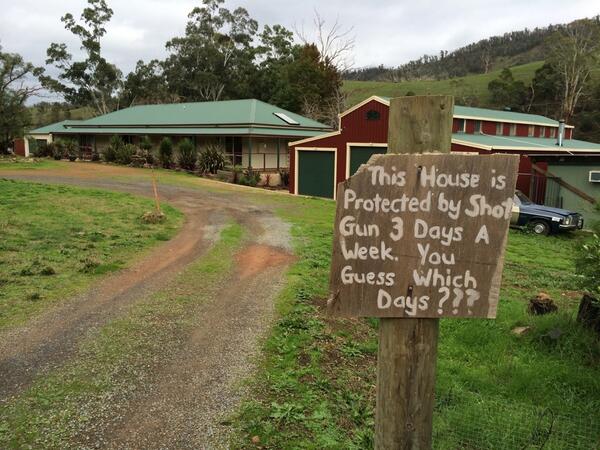
David McCoy complains about a sign reading "No Dumping - Violators May Be Prosecuted". He objects to the permissive and non-threatening implications of the modal verb "May", and is nostalgic for the unequivocal days of right and wrong, of firm laws and firm enforcement of the laws, when cardboard signs read "Trespassers Will Be Shot". [Modal Verbs: The Words Behind the Loopholes ]

I want to make two points here. The first relates to the purpose of the sign - what is it trying to achieve, and what kind of language is appropriate to this purpose. The second point relates the nature of ambiguity - is May really more ambiguous than Will?


The purpose of signs like these is of course admonitory - they are designed to dissuade people from doing something. You might think that an uncertain sanction (may be prosecuted) is less of a disincentive than a certain sanction (will be shot).

But then which of the following warning signs do you find most persuasive? Perhaps it depends on your national culture. We British are a nation of accountants, so we like to be told what the maximum fine is.
  • British: If you climb on this electricity pylon you will be fined £100
  • German/American: It is a Federal Offence to climb on this electricity pylon.
  • Italian: If you climb on this pylon you may die.
(I inherited this joke from my father, but I don't know whether it was his own observation or he got it from somewhere else. I think there may have been a French one as well. Please comment if you have a source, or any other nationalities.)

Based on the simple linguistic analysis David recommends, the possibility of death is not as strong a sanction as the certainty of a fine. Like Hermione's joke in the first Harry Potter book - "We could all have been killed - or worse, expelled."

David likes warnings to be proper threatening. When I was growing up, parents and teachers said things like "Don't do that or else": that was regarded as proper threatening in the days of "unequivocal days of right and wrong, of firm laws and firm enforcement of the laws". So we usually did what we were told and didn't find out what the punishment would have been.

Following David's logic, parents should say things like "Don't do that or else you will be grounded for three days and fined 2 weeks pocket money." But is precise specification of the sanction really more effective in encouraging good behaviour? Or does it merely encourage calculated risk-taking?


Meanwhile, “Trespassers Will” is still pretty indefinite. Does it mean ALL trespassers or SOME? Immediately or later? If I trespass and I am not shot, is that a counter-example or a stay of execution? If no trespassers have ever been shot, what should I conclude from that? Do I want to be the first?

Perhaps it would be better to have a sign, like road safety signs, saying “341 trespassers have been shot this year. Some of them survived. Please take your litter home.”

Or perhaps this …

Next to his house was a piece of broken board which had: “TRESPASSERS W” on it. When Christopher Robin asked the Piglet what it meant, he said it was his grandfather’s name…it was short for Trespassers Will, which was short for Trespassers William. And his grandfather had had two names in case he lost one—Trespassers after an uncle, and William after Trespassers.


I agree with David that the English language is tricky. But I think he is wrong to blame modal verbs - may, can, shall, might, etc. - which he identifies as "the words that power loopholes." These words tend to be used consciously, not to create inadvertent loopholes but to deliberately underspecify some outcome. In David's example, the rule is pretty clear ("No Dumping") but the sanction is underspecified ("Violators May").

Meanwhile, "Trespassers Will" is a false universal, with no modal word to draw your attention to the ambiguity. In my opinion, this kind of ambiguity is much more dangerous - both when used deliberately, to mislead or persuade, or when used inadvertently.

Some people find the NLP metamodel useful for identifying structural ambiguities in English speech. (Other people think NLP is the work of the devil, but of course the devil is in the detail.) All structural ambiguities, or just some? I suspect there is no assured method for eliminating all possible ambiguity.

See also Unambiguous Threat (September 2005), Good Ideas from Flaky Sources (December 2009)


Update: Here's a great example, found by @ShawnCallahan

Embedded image permalink
Updated 8 June 2014

Monday, November 03, 2008

Commander in Chief

In a democracy, the army is ultimately accountable to the people. In America this principle is embedded not only in the US Constitution, but also in the formation of West Point (the military academy), as Simon Schama explains in his latest book-cum-TV-documentary "The American Future". [Reviews: Spectator, Sunday Times, Telegraph, The Scotsman]

So when American civilians refer to the president as "our commander in chief", what they really mean is THE commander in chief of OUR army, commanding the military might of America on behalf of the American people.

Or do they?

Glen Greenwald calls this The single worst expression in American politics and points to an article by Gary Wills (At Ease Mr President) as well as an earlier item of his own (Public Servant v Military Commander). See also Digby on the Divine Right of Republicans.

There are many clumsy and inaccurate expressions in political life, so what makes this one particularly bad? Wills and Greenwald point to the Orwellian effects of this expression.
"The citizenry at large is now thought of as under military discipline. ... The glorification of the president as a war leader is registered in numerous and substantial executive aggrandizements; but it is symbolized in other ways that, while small in themselves, dispose the citizenry to accept those aggrandizements." [Wills]

"President Bush's supporters are fond of referring to him as the "commander in chief" -- typically to insinuate that he should be beyond criticism or that his authority cannot be questioned." [Greenwald]

"The more the President is glorified and elevated (he's not merely a public servant or a political official, but "our Commander in Chief"), the more natural it is to believe that he should have the power to do what he wants without anyone interfering or questioning." [Greenwald]
Thus there is a strong suspicion that people are choosing to use this inaccurate expression because they welcome these effects, making this an interesting and important example of the political effect of language. Now Joe Biden is also embracing what Jonathan Schwartz calls "this creepy tradition". Is this an ominous hint at the authoritarian intentions of a future Democratic administration?